
I’m part of a Tuesday morning business group and as usual, we held our meeting this morning. As the meeting progressed, I noticed a dip in the energy levels of the group. They are a great bunch of people, who even when facing the truth of our current situation, manage to maintain a strong sense of humour and high spirits. But this morning was different.
It’s not surprising really. We are now in week 5 of a national lockdown. The lockdown has been extended for another three weeks and most people probably think it will last longer. And I think that with the realisation of where we are, a little fear and some unhappy resolution is beginning to settle in.
What was interesting to me, wasn’t the low energy, but the fact that no one mentioned it. There is an unhealthy false positive that is being pushed. Some might call it the British stiff upper lip – just getting on with it. But this is not always healthy. All over we’re encouraged to keep positive, and although I agree with that to some degree, I know that this is not possible for everyone, all of the time. We need to understand that we’re going through a change, and change is a process with specific stages.
Some people are not feeling positive just now, and actually, this is okay. I strongly believe that we should embrace all of our emotions and not try to avoid the ones that don’t make us feel so good. As long as we don’t spend our lives in those more negative emotions for too long. Each emotion brings with it a message about something we need to pay attention to, in that moment.
As we go through this pandemic, we are all going to go through different emotional states. This is normal and we should accept and expect these changes.
The push to remain positive and upbeat has its roots and motivations in a variety of different places. These could be political, survival, etc. but it’s not realistic to expect everyone to remain full of energy and upbeat all of the time. Acknowledging where we are and how we’re feeling will allow others to openly acknowledge as well. This is a far healthier state of being both individually and collectively. People will not then feel that they cannot honestly talk about their fears and concerns. I would always add the proviso that we all need to find a way forward from that place though.
What most people haven’t realised as we go through this pandemic is that we’re going through a period of change. I keep hearing the phrase ‘when we get back to normal’. The truth is we will be creating a new normal. Things will not be going back to what it was like before this all started.
Let me share with you what happens during the change.
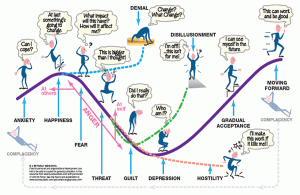
First of all, it’s important that we understand that change is a process, and this process has several stages.
- In the first week or so we were stressed out asking the question, ‘Can I cope with this?’. We are in a stage of high anxiety.
- Then, we are a little more optimistic either believing that everything is going to work out okay, or we may be in denial. We may still feel relatively happy about things. Some people may choose to remain in a state of denial, openly questioning whether real change is happening at all.
- In stage three we begin to wonder what the impact of this will be. How will this affect me? My business, family, etc. The fear factor begins to enter our thinking and emotions.
- In stage four we begin to see the situation as more of a threat, with thoughts such as this is continuing for longer than I expected. Or this is a bigger issue than I thought it might be.
- At stage five you may begin to take things even more personally, having a sense of guilt.
- Feeling a sense of guilt and wondering how you could have brought this on yourself somehow.
- Disillusionment may kick in. Wanting to abandon the situation, the business, etc.
- Stage six is a state of depression. This may not mean clinical depression, but unhappiness and despair may well come into it. Questioning yourself – who am I?
- From here the choices are:
- A gradual acceptance of the situation through which you begin to move forward. Some people may begin to see possibilities. They may begin to have thoughts such as ‘I can see myself in the future. This can work out for me and even be a good thing.’ Or,
- Hostility may set in. Some people may well become stuck in the negative spiral of not wanting to accept the change. They may become resentful, angry and uncooperative, trying to maintain the previous status quo.
Each individual may go through this process differently. It is not necessarily linear neither will each person experience each stage specifically. How long it takes an individual or organisation to work through this change is dependent on the right leadership, in the case of an organisation, and developing the right mindset in the case of the individual.
Change is a process that has a curve. There is a lot more to it than I’ve mentioned here and at times things get worse before they can begin to get better.
Watch for the signs in yourself and in your staff and know that each step is a necessary part of getting through this. And we will get through this, but the better prepared we are for dealing with each stage of the process the more likely we are to achieve a better outcome. Being aware of the stages of change will help us in that preparation.
Understand that the staff member who appears to have little motivation, struggling to get work done or stuck in the stage of worry or fear is not just being difficult. He or she is naturally going through this process of change.
As a leader or manager, your role is to support your team through this process. Are you aware of how to do this at each stage? It’s your job to support, motivate and help your team members to get the best out of themselves.

Leave a Reply
You must be logged in to post a comment.